
A substation (pencawang) is a capital asset that is expected to run for decades. Whether it fulfils that expectation depends less on the day it was commissioned and more on how it is looked after year after year. Planned preventive maintenance keeps the equipment healthy, keeps your operation compliant, and — most importantly — keeps people safe around live electrical apparatus.
Why preventive maintenance matters
There are three reasons every operator in Malaysia should take PPM seriously:
- Avoiding unplanned outages. An unexpected transformer or switchgear failure can take a facility offline for hours or days. A planned shutdown of a few hours, scheduled at a convenient time, is far cheaper than emergency repairs and lost production.
- Extending asset life. Clean, dry, correctly-torqued and well-lubricated equipment simply lasts longer. Moisture, dust, vibration and heat are what age a substation prematurely — and all four are controllable through routine servicing.
- Safety and compliance. Live 11kV apparatus is unforgiving. Regular maintenance verifies that protection, earthing and interlocks still work, keeping you aligned with Tenaga Nasional Berhad (TNB) requirements, Suruhanjaya Tenaga (the Energy Commission) rules and DOSH workplace safety obligations.
The 2026 substation PPM checklist
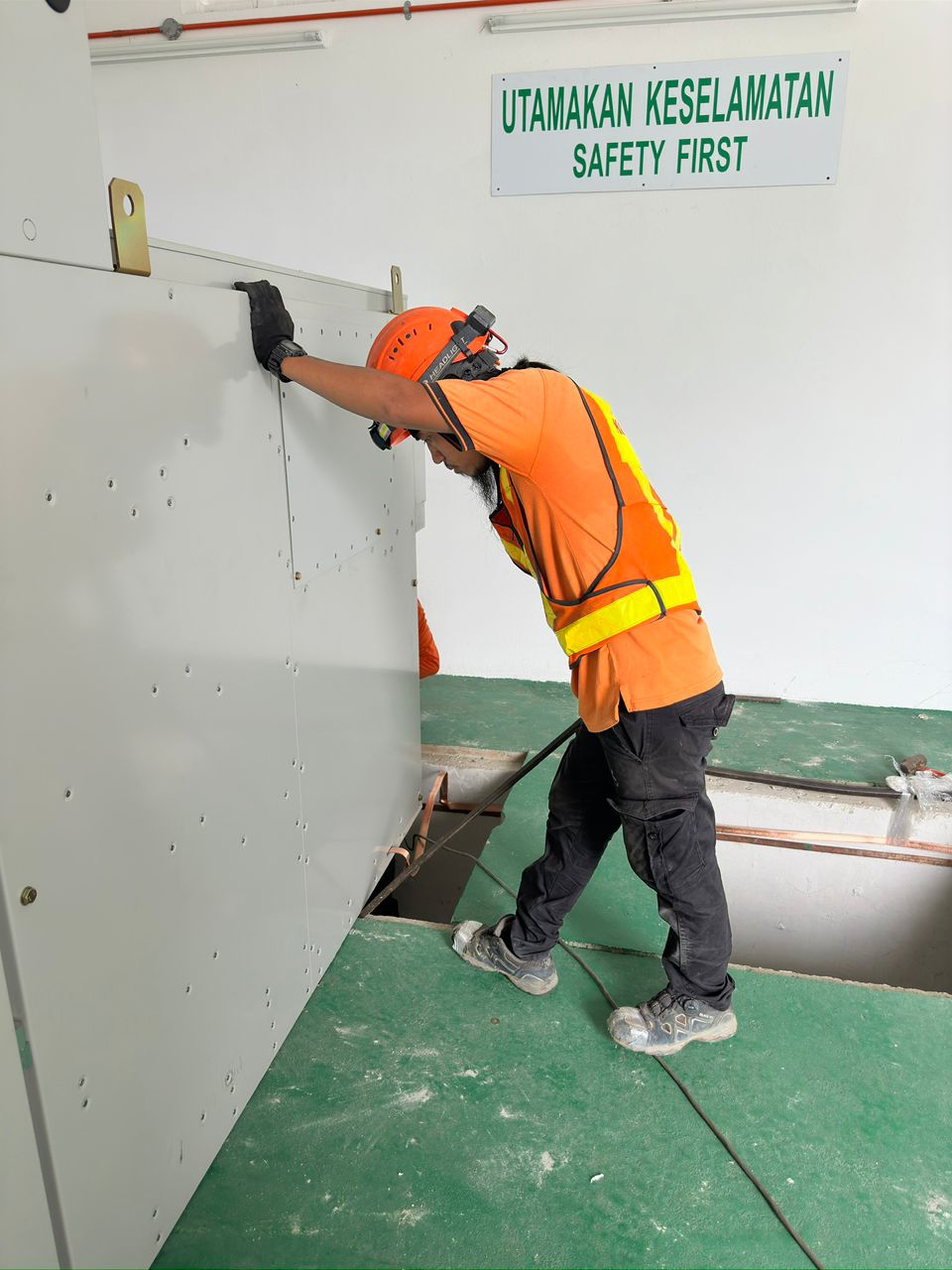
The following tasks form the backbone of a full 11kV preventive maintenance programme. Suggested intervals are a starting point — high-load, coastal or dusty environments in Malaysia often justify shortening them.
1. Transformer service
- Check and top up insulating oil level; sample oil for dielectric strength and, where required, dissolved gas analysis (annual).
- Inspect and replace the silica-gel breather — pink crystals mean the desiccant is saturated and moisture is getting in (quarterly).
- Clean and examine bushings for cracks, tracking or flashover marks; check tightness of terminals (annual).
- Verify cooling fins, gaskets and the Buchholz/temperature devices are intact and leak-free (annual).
2. RMU & switchgear inspection
- Inspect the Ring Main Unit (RMU) and switchgear for gas pressure (SF6), oil level or vacuum integrity as applicable (quarterly).
- Lubricate operating mechanisms, linkages and interlocks; confirm smooth open/close operation (annual).
- Check contact resistance and busbar joint tightness; look for signs of overheating or discolouration (annual).
3. LV board & feeder pillar checks
- Tighten and torque-check all incoming and outgoing terminations (annual).
- Test ACBs/MCCBs for correct operation and trip settings; exercise mechanisms that rarely move (annual).
- Inspect feeder pillars for water ingress, corrosion and pest intrusion (quarterly).
4. Protection relay function test
- Secondary-inject each protection relay to confirm pick-up and trip times match the approved settings (annual).
- Verify CT/VT circuits, tripping paths and interlock logic actually operate the correct breaker (annual).
5. DC battery & charger checks
- Measure individual battery cell voltages and specific gravity; check for bulging, leakage or corroded terminals (quarterly).
- Confirm the charger holds the correct float and boost voltages, and that the battery can hold up the tripping supply during an AC failure (annual).
6. Earthing resistance test
- Measure earth electrode resistance and confirm it remains within the design limit; inspect earth bonds and connections for corrosion (annual, ideally in the dry season for a worst-case reading).
7. Thermographic / infrared scanning
- Carry out infrared thermographic scanning of joints, busbars, cable terminations and breaker contacts while the substation is on load. A hot spot signals a loose or corroded connection with rising resistance — caught early, it is a five-minute re-torque; ignored, it is a burnout (annual, or six-monthly for critical installations).
8. Cleaning, housekeeping & insulation resistance
- Clean panels, insulators and cable boxes of dust, dirt and lizard/rodent debris; confirm ventilation, lighting and door seals are sound (quarterly).
- Measure insulation resistance of cables, windings and busbars with a megger to trend the condition of insulation over time (annual).
Signs that need urgent attention: a burning or fishy smell, audible buzzing or crackling, visible discolouration or soot on terminals, oil leaks, a saturated (pink) breather, repeated nuisance tripping, or a DC battery that will not hold voltage. Any of these should trigger an inspection immediately — do not wait for the next scheduled visit.
Building a workable maintenance schedule
A practical way to structure PPM is to tier it by frequency:
- Monthly / quarterly — visual inspections, housekeeping, breather and battery checks, and infrared spot-checks that need no shutdown.
- Annual — the full shutdown programme: transformer service, switchgear servicing, relay function testing, insulation and earthing measurements, and torque verification.
- Condition-based — extra attention driven by trending data, thermographic findings, load growth or the age of the asset.
Keeping records is what turns maintenance into insight. When each visit is documented, you can trend insulation values, oil quality and hot-spot temperatures over the years and predict failures before they happen.

Why use a licensed TNB contractor for PPM?
Preventive maintenance on live 11kV apparatus is not routine facilities work. It demands calibrated test instruments, a working knowledge of protection schemes, strict safety procedures, and legally, competent persons registered with Suruhanjaya Tenaga. As a TNB Rakaniaga Strategik (Strategic Business Partner) established in 1993, NIKKISO-AYSHA has maintained 11kV substations across Pulau Pinang and the northern region for over 30 years, backed by ST-registered engineers and full documentation on every visit.
Key takeaways
- Preventive maintenance catches faults on your schedule — before they become unplanned outages.
- The core checklist covers transformer, RMU/switchgear, LV board, relays, DC battery, earthing, thermography, cleaning and insulation resistance.
- Tier the work into monthly/quarterly checks and a full annual shutdown, and keep records to trend asset health.
- In Malaysia, PPM must be done by ST-registered competent persons working to TNB and DOSH standards.
Frequently asked questions
What is electrical preventive maintenance for a substation?
It is a planned programme of inspection, testing, cleaning and servicing carried out at fixed intervals to keep a substation safe and reliable. Rather than waiting for equipment to fail, PPM finds developing faults early — loose joints, moisture, worn contacts or a weak battery — so they can be corrected during a planned shutdown.
How often should an 11kV substation be maintained in Malaysia?
Most installations follow a tiered schedule: light monthly or quarterly visual and housekeeping checks, and a full annual shutdown covering transformer service, switchgear, relay testing, DC battery, earthing and insulation. Critical or high-load sites are serviced more often.
What does thermographic (infrared) scanning detect?
It detects abnormal heat at joints, busbars, terminations and contacts while the substation is live. A hot spot usually means a loose or corroded connection with rising resistance — an early warning of a joint that could eventually arc or burn out.
Who should carry out substation preventive maintenance?
Competent persons registered with Suruhanjaya Tenaga, working to TNB standards and DOSH safety requirements. NIKKISO-AYSHA provides ST-registered Chargemen and Competent Engineers, calibrated instruments and full documentation for 11kV PPM.